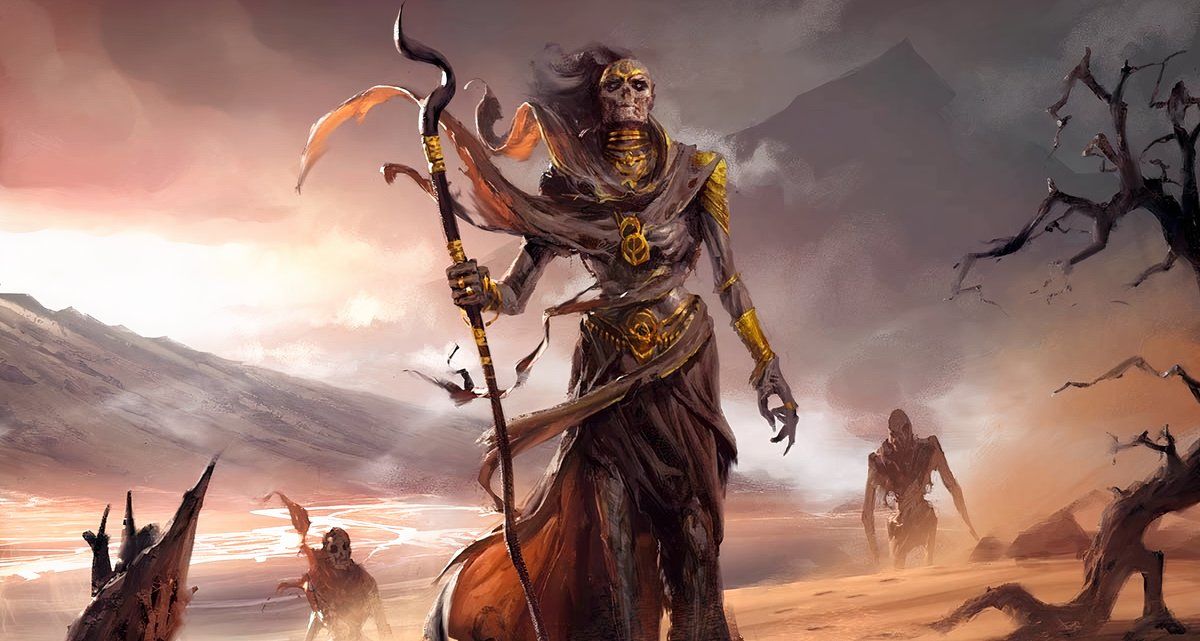
Everyone knows how this story ends. A brave but probably foolish archaeologist ventures into an ancient tomb, perhaps accompanied by a small crew of explorers. They carefully dodge traps while ignoring ominous warnings etched into stone walls in ancient hieroglyphics. Once the sarcophagus is disturbed, the mummy rises from its eternal slumber to immediately claim its first victim. Even if some intruders manage to survive the initial encounter, they’re almost always cursed — destined to be hunted down until the mummy devours their souls. Remarkably, Magic: The Gathering once managed to tell that entire cinematic horror story through the mechanics on just one card. It’s a shame that this brilliant piece of game design has been buried and forgotten for more than 15 years.
The Art of Storytelling Through Game Mechanics
In the world of collectible card games, few achievements are as impressive as conveying a complete narrative through mechanical design alone. Magic: The Gathering, created by mathematician Richard Garfield and first published by Wizards of the Coast in 1993, has always excelled at blending fantasy storytelling with strategic gameplay. Over its three-decade history, the game has produced thousands of cards, but only a select few manage to tell a story so effectively that players can visualize the entire scene unfolding simply by reading the card’s abilities. The forgotten mummy card in question accomplishes this rare feat by mechanically representing every beat of the classic horror movie trope — from the initial tomb disturbance to the inevitable supernatural vengeance.
Magic designers have long discussed the concept of “top-down design,” where cards are created starting with a flavor concept rather than pure mechanical considerations. This approach became particularly prominent during sets like Innistrad, which embraced gothic horror themes, and the original Amonkhet block, which drew heavily from Egyptian mythology. However, the elegant horror storytelling found in older forgotten cards sometimes surpasses even these celebrated modern examples. When a card’s mechanics perfectly mirror its narrative, players experience what designers call “resonance” — an intuitive understanding that makes the game feel alive and immersive.
The Renaissance of Vintage Card Design
The recent call from Magic designers to resurrect this particular card reflects a growing appreciation within the gaming community for vintage design philosophy. In the early years of Magic, designers often experimented more freely with complex or unusual mechanics that might be considered too complicated for modern design standards. Today’s philosophy emphasizes what the company calls “New World Order,” which limits complexity at common rarity to make the game more accessible to newcomers. While this approach has successfully broadened Magic’s audience to millions of players worldwide, it has sometimes come at the cost of the intricate mechanical storytelling found in older cards.
Industry analysts note that nostalgia plays a significant role in Magic’s enduring success. The game generates approximately one billion dollars in annual revenue, with many players maintaining collections spanning decades. Wizards of the Coast has increasingly tapped into this sentiment through products like Modern Horizons and various reprint sets that bring beloved old cards back into circulation. The desire to revive forgotten gems that tell perfect miniature stories represents both an artistic and commercial opportunity — these cards often become beloved by new generations of players who discover them for the first time.
Horror and Fantasy Gaming’s Enduring Appeal
The mummy horror archetype that this card embodies has roots stretching back to ancient folklore and gained modern popularity through films like Universal’s 1932 classic “The Mummy” starring Boris Karloff. This enduring fascination with cursed tombs and vengeful undead has made Egyptian horror a recurring theme in games, literature, and cinema. Magic: The Gathering has explored this territory multiple times, most notably in the Amonkhet and Hour of Devastation sets released in 2017, which featured an entire civilization built around death, mummification, and the god-pharaoh Nicol Bolas.
The broader tabletop gaming industry continues to thrive, with the global market valued at over thirteen billion dollars. Horror-themed games consistently rank among the most popular, suggesting that the appetite for cards that tell spooky stories remains strong. As Magic approaches its thirty-second anniversary, the push to unearth design treasures from its past demonstrates how the game continues to evolve while honoring the creative innovations that made it a cultural phenomenon. Whether this particular forgotten card will see print again remains uncertain, but the conversation itself highlights the remarkable artistry possible within the confines of a small rectangular playing card.
Expert Opinion: The movement to resurrect mechanically-storytelling cards like this forgotten mummy represents a broader industry trend toward valuing narrative elegance in game design. As digital gaming increasingly dominates entertainment, tabletop games differentiate themselves through tactile, imaginative experiences that algorithms cannot replicate. Expect Wizards of the Coast to mine their extensive back catalog more aggressively in coming years, bringing dormant design gems to new audiences while satisfying veteran players’ nostalgia.