After two decades of silence, Capcom is finally reviving its beloved Onimusha franchise with the highly anticipated Onimusha: Way of the Sword, set to launch in September 2025. While the game brings back many beloved elements that defined the original series—intense swordplay, hordes of demons known as Genma, and the iconic Oni Gauntlet—it also introduces compelling new narrative elements. Among the most intriguing additions is Shizuka, a mysterious woman who exists within the protagonist’s supernatural weapon, creating a unique dynamic that promises to reshape how players experience the Onimusha universe.
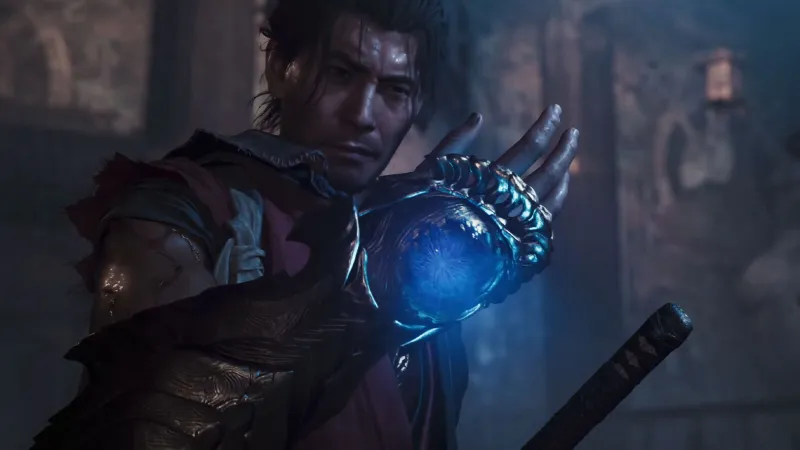
The game’s protagonist is none other than the legendary historical samurai Miyamoto Musashi, rendered using the likeness of the late iconic Japanese actor Toshirō Mifune. Set during the early Edo period in Kyoto, Way of the Sword takes players through an “open-town” section of Japan’s ancient capital, offering a fresh setting for the franchise. Musashi’s relationship with the Oni Gauntlet differs dramatically from previous heroes in the series. Unlike Samanosuke Akechi from Onimusha: Warlords or Jūbei Yagyu from Onimusha 2: Samurai’s Destiny, who embraced the supernatural powers granted by the Oni, Musashi actively despises the gauntlet affixed to his arm.
A Warrior’s Reluctant Partnership
Game director Satoru Nihei explained this fascinating character dynamic in recent interviews conducted at Capcom’s Osaka headquarters. “Musashi is a hero who wants to rise to the top on his own strengths, so him being paired with the gauntlet—this power that he doesn’t want—we thought provides an interesting contrast to the previous heroes we’ve had,” Nihei revealed. The historical Miyamoto Musashi was indeed renowned for his pursuit of martial perfection through skill and discipline alone, having authored “The Book of Five Rings,” one of Japan’s most celebrated texts on strategy and swordsmanship. This character trait creates immediate tension when he’s forced to rely on supernatural assistance.
While the exact circumstances of how Musashi acquires the Oni Gauntlet remain shrouded in mystery, it’s clear he desperately wants it removed. He believes that defeating more Genma and collecting their souls will eventually free him from this unwanted burden. However, Nihei hints at character development throughout the narrative: “But, as the story progresses, and as he moves on, we kind of see some growth, and he starts to change his opinions on the gauntlet.” This evolution suggests that Shizuka, trapped within the gauntlet, plays a crucial role in transforming Musashi’s perspective.
Shizuka’s Origins and Narrative Purpose
Lead writer Hiroshi Yamashita shed light on the creative reasoning behind Shizuka’s existence in the game. Beyond her narrative importance, she serves a practical design function for Capcom’s global audience. “On a game design level, with the setting of Kyoto, not everyone is familiar with the setting, especially a global audience,” Yamashita explained. “When we were making the game, with Musashi coming to Kyoto on his own, we kind of wondered, ‘How are we going to convey a lot of that information to players?’ We thought we could just have Musashi walk in the streets, talking and mumbling to himself, but that would be very unnatural and strange.” Thus, Shizuka emerged as an organic solution—a support character who could naturally explain the world, the Genma threat, and historical context to both Musashi and players alike.
However, the development team was adamant that Shizuka not exist merely as an exposition device. Yamashita confirmed that her presence has deep narrative justification: “Something happens to her and she ends up escaping to the gauntlet, so she is in this position where she has something that she wants to achieve, she has a goal, but she doesn’t have a physical form, she can’t fight for herself, and so she’s having to entrust Musashi with this duty.” This creates a compelling symbiotic relationship where both characters need each other despite their initial reluctance. The Onimusha series has always excelled at blending supernatural horror with historical Japanese settings, and Shizuka represents an evolution of this storytelling tradition.
The Evolving Relationship Dynamic
The relationship between Musashi and Shizuka begins with considerable friction. Yamashita described their early interactions as distant and confrontational, with the two characters frequently butting heads. This tension mirrors Musashi’s general disdain for relying on anything beyond his own abilities. Yet as the story unfolds, their dynamic shifts significantly. “As the story progresses, we see that relationship change a bit as she is quite key to the story itself,” Yamashita noted. Early hands-on previews suggest hints of potential camaraderie, perhaps even romance, developing between the unlikely pair. Shizuka expresses remorse for dragging Musashi into her predicament while simultaneously needing his help to eventually escape the gauntlet’s confines.
One concern players often have with companion characters in action games is the potential for them to become annoying or intrusive. Yamashita acknowledged this challenge, revealing that the development team carefully studied other game companions to understand what works and what doesn’t. Based on early gameplay sessions lasting several hours at Capcom’s headquarters, journalists report that Shizuka’s presence feels natural rather than grating—a promising sign for the full release. The Onimusha franchise has always prioritized atmospheric storytelling, and Shizuka appears to enhance rather than detract from that experience. With Way of the Sword launching on September 4, fans won’t have to wait long to discover the full extent of Shizuka’s mysteries and her importance to Capcom’s ambitious return to one of its most beloved action franchises.
Expert Opinion: Capcom’s decision to introduce Shizuka as an ethereal companion represents a sophisticated evolution in action game narrative design. By embedding a support character directly within the protagonist’s weapon, the developers have created an intimate storytelling mechanism that avoids the pitfalls of traditional escort missions while providing organic world-building opportunities. If executed successfully, this approach could influence how future action games handle exposition and character development, potentially establishing a new template for companion dynamics in the genre.