The automation genre has become increasingly codified over the past decade, with players coming to expect certain familiar mechanics whenever they boot up a new factory-building experience. Conveyor belts, assemblers of varying complexity, refiners, and resource management systems have become the standard toolkit that developers work with. However, the newly announced Sandustry is challenging these conventions by asking a fundamental question: what if automation didn’t have to mean building a factory at all?
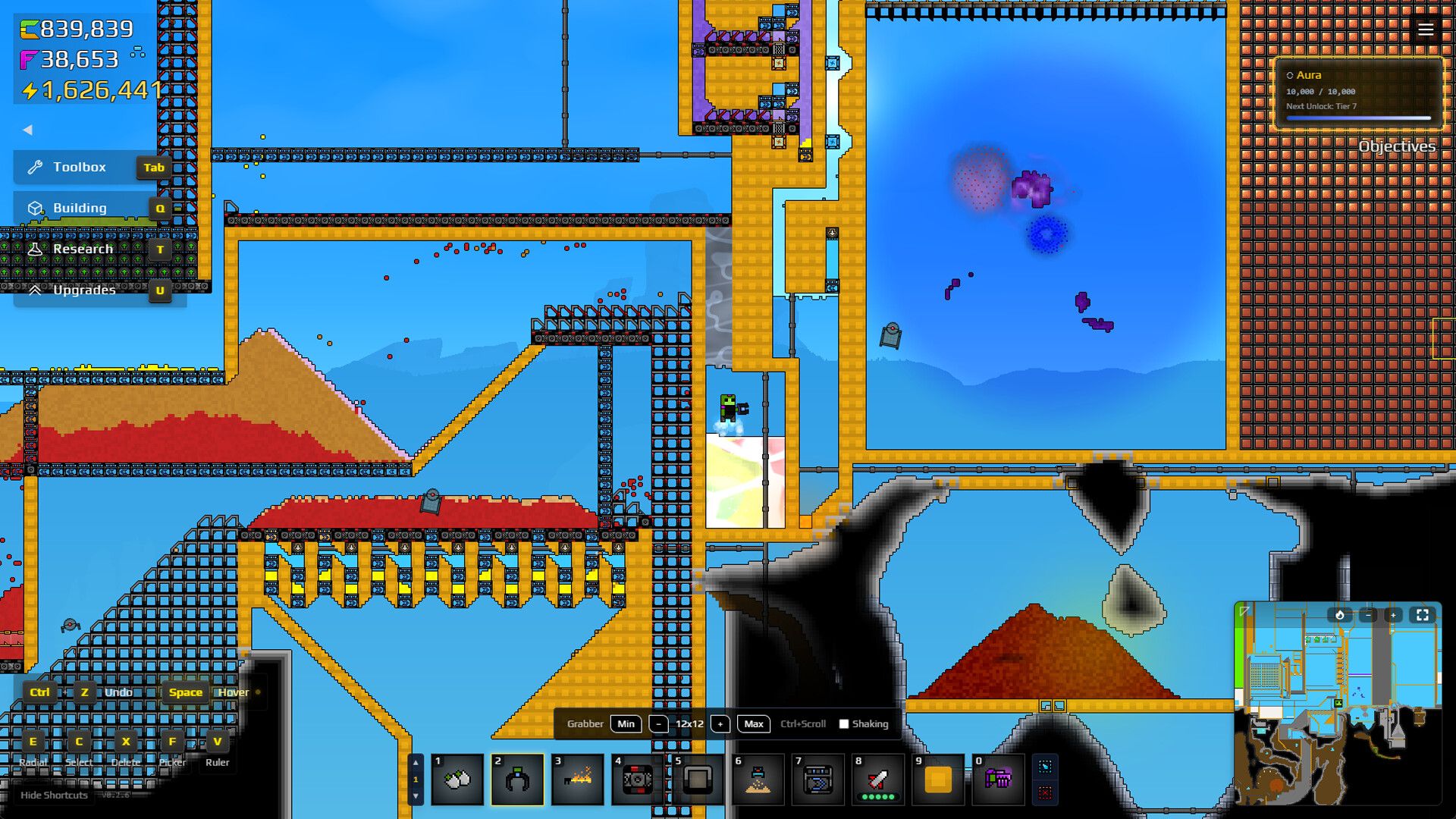
The launch trailer for Sandustry reveals a game that takes the core satisfaction of automation gaming — watching complex systems work in harmony — and transplants it into an entirely different context. Instead of constructing sprawling industrial facilities on alien worlds, players will dig deep into a brand new planet, creating elaborate underground networks that process resources in innovative ways. This fresh approach demonstrates that the genre still has room for creative exploration beyond its established formulas.
The Evolution of Automation Gaming
To understand why Sandustry represents such a notable departure, it helps to trace the automation genre’s relatively brief but impactful history. While SpaceChem in 2011 planted the seeds for what would become a beloved gaming niche, it was Factorio’s early access release in 2016 that truly defined the modern automation game. That title established many of the conventions players now take for granted: the overhead perspective, the emphasis on efficiency optimization, and the satisfying progression from simple manual crafting to complex automated production chains.
Since Factorio’s success, numerous titles have iterated on its formula while adding their own distinctive elements. Satisfactory brought the genre into first-person 3D space, allowing players to walk through their creations. Shapez and its sequel focused on abstract shape manipulation rather than realistic resource processing. Foundry emphasized verticality and three-dimensional factory design. Each game found ways to differentiate itself while still adhering to the fundamental grammar of conveyor belts, inserters, and assemblers that Factorio popularized.
Breaking the Mold With Underground Exploration
Sandustry appears poised to challenge these assumptions by shifting the focus from surface-level factory construction to subterranean excavation and resource processing. The trailer showcases gameplay that emphasizes digging, terraforming, and creating underground infrastructure rather than simply placing buildings on a flat plane. This approach opens up new design possibilities that traditional factory games haven’t fully explored, including dealing with gravity, structural integrity, and the three-dimensional nature of underground spaces in more meaningful ways.
The game’s setting on a newly discovered planet adds narrative context to the mechanical innovations. Players aren’t just building efficient systems for their own sake — they’re pioneering the development of an unexplored world. This combination of exploration and automation could appeal to fans of both genres, potentially expanding the audience for this style of gameplay. The trailer suggests a progression system where players gradually unlock new tools and capabilities as they delve deeper into the planet’s crust, discovering new resources and challenges along the way.
What This Means for the Genre’s Future
The announcement of Sandustry reflects a broader trend in gaming where established genres are being deconstructed and recombined in novel ways. Just as the soulslike genre has expanded beyond its dark fantasy origins to encompass science fiction and even 2D platforming, automation games are beginning to explore territory beyond traditional factory settings. This evolution is healthy for the genre’s long-term vitality, as it prevents stagnation and attracts new players who might not have been interested in conventional factory builders.
Industry observers note that the automation genre has proven remarkably resilient in the indie gaming space, with new titles consistently finding dedicated audiences. The success of games like Satisfactory, which sold millions of copies, demonstrates substantial demand for this style of gameplay. By offering a fresh take on familiar concepts, Sandustry positions itself to capture both existing automation enthusiasts looking for something new and newcomers intrigued by its unique premise. As the game moves toward release, it will be fascinating to see how its underground focus influences the mechanics and systems that players will need to master.
Expert Opinion: Sandustry represents an important inflection point for the automation genre, demonstrating that the core appeal of these games — creating elegant, self-sustaining systems — can be successfully transplanted into entirely new contexts. As the market for traditional factory builders becomes increasingly crowded, we can expect more developers to experiment with hybrid approaches that blend automation mechanics with other genres like exploration, survival, or city-building. This diversification will likely accelerate over the next few years.